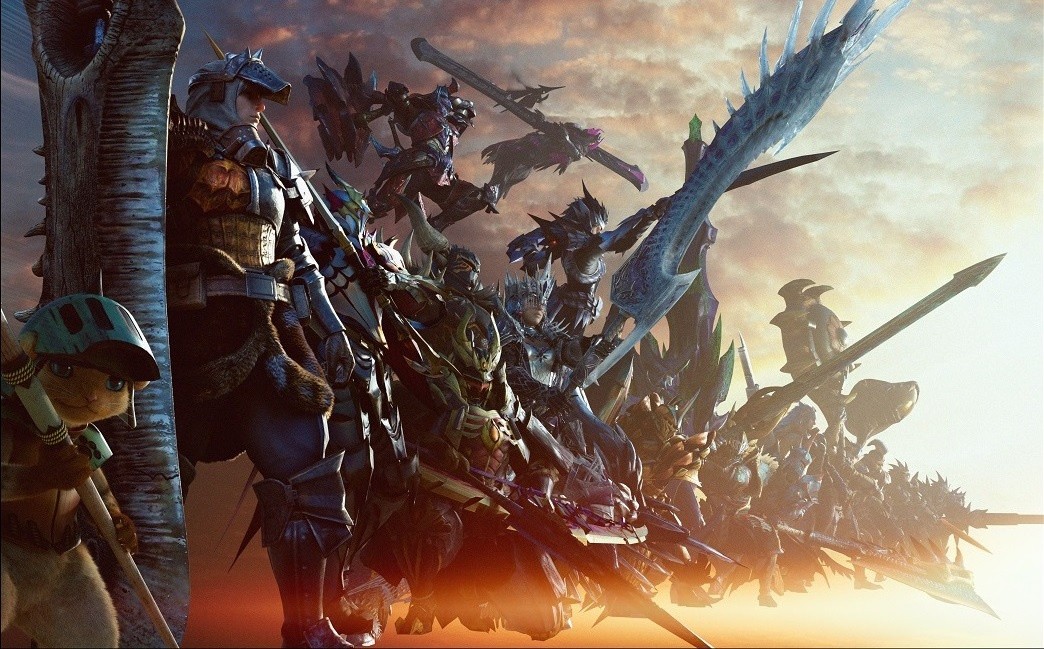
Featured image: Monster Hunter 20th Anniversary artwork by Capcom
The latest Josh Strife Hayes video is about Ashes of Creation shutting down, and while I couldn’t care less about that specific game, the man said something that’s been rattling around in my head ever since.
His argument: MMO players aren’t buying games. They’re buying the dream of a community. The mechanics are mediocre, the grind is repetitive, and what actually keeps people around is the guild, the friends, the feeling of belonging. The people throwing thousands at Kickstarter MMOs that will never ship? They’re not funding a product. They’re placing a down payment on a social life they don’t currently have.
Now - Monster Hunter isn’t a one-to-one comparison here. Unlike most MMOs, the core gameplay is genuinely excellent. People do buy Monster Hunter for the hunting. The combat has real depth, the weapon variety is insane, and the satisfaction of finally reading a monster’s patterns and taking it down cleanly is something very few games can match. This isn’t a tab-target snoozefest where the gameplay is just filler between social interactions.
But here’s the thing - even with gameplay this good, it’s not what keeps people playing for thousands of hours. The hunting gets you in the door. The community is what makes you stay. And everything that’s gone sideways with the franchise post-World starts making a lot more sense when you look at it through Josh’s lens.
The Gathering Hall Was the Point
Josh calls MMOs “old-fashioned chat rooms with a game attached.” Social hangouts where the mechanics are just the excuse.
That’s Monster Hunter - by design. The original game was literally born from Capcom’s initiative to make online multiplayer console games. It was one of three PS2 projects - alongside Resident Evil: Outbreak and Auto Modellista - built specifically to explore online connectivity. Kaname Fujioka, the director, has talked about how cooperative hunting was the foundation everything else was built on top of. Capcom’s own 20th anniversary materials describe the vision as “hunting action for all, anticipating that the day would come when players could connect with friends online and enjoy cooperative play.” The hunting action, the weapon weight, the monster ecology - all of that came after the multiplayer concept. Community wasn’t a bonus feature. It was the blueprint.
And it worked. Think about MHGU or 4U. You sat in a Gathering Hall with three other hunters. You saw their gear, posted a quest, waited for people to ready up. Sometimes you just hung out. The lobbies were small, the loading was slow, and none of that mattered because the friction forced you to actually be present with the people you were playing with.
Nobody came back to MHGU at midnight for optimal damage calculations. They came back because their hunting group was online and the Discord call that started as “one more hunt” always turned into four hours of nonsense.
The community was the game. The hunts were just what you did together.
And here’s a fallacy that’s been quietly poisoning the well for years: the idea that soloing hub quests is the “real” way to play Monster Hunter. Speedrunners put solo play on a pedestal because that’s how you get clean times and controlled runs. And regular players absorbed that mentality without questioning it. “I soloed all of G-rank” became a badge of honor. Asking for help became something to be embarrassed about.
But hub quests were designed for multiplayer. That’s why they have scaled HP. That’s why the Gathering Hall exists. The entire structure of the game was built around the assumption that you’d be playing with other people. Soloing hub was always possible - the same way you can eat soup with a fork - but it was never the intended experience. The game was literally built from the ground up as a cooperative multiplayer experience, and somewhere along the way the community decided the “correct” way to play was to ignore that entirely.
This solo worship did real damage. It pushed new players away from the multiplayer experience that makes Monster Hunter special. It turned what should be a social game into a solo challenge run where asking for help is weakness. And it fed directly into the design philosophy that gave us the SOS flare - because if everyone’s soloing anyway, why bother building spaces for people to actually hang out?
The Happy Hunters Aren’t on Reddit
Josh’s sharpest observation: the players content with their game and community aren’t screaming for revolution online. They’re just playing. The loudest voices are the displaced - people who lost their community or never found one.
In Monster Hunter, this is mostly true. The hunters who came up through Freedom Unite, Tri, 4U, Generations - a lot of them are still around, in private Discord servers organizing hunts, booting up MHGU for the thousandth time. They’re not demanding revolution.
There’s also veterans who are loud, not because they’re displaced, but because they’re gatekeeping. A real contingent of old-guard players who shit on new players and new entries because the games aren’t carbon copies of Freedom Unite. They sneer at anyone who started with World. They treat quality-of-life improvements like personal insults. Their community isn’t built around a game - it’s built around having suffered through a harder version and resenting anyone who didn’t.
Then there’s the third group: World-era players who came in during the population boom, experienced the game but missed the culture. They never had a crew. They had a product they consumed, finished, and moved on from. When World’s lifecycle ended, they didn’t have a hunting party to fall back on. They had an empty friends list.
World: The Fresh Start That Couldn’t Hold
Josh describes the euphoria of a new MMO launch - everyone’s equal, no hierarchy, connections form effortlessly because everybody needs each other. That was World. Millions flooding in. Veterans learning alongside newcomers. Electric.
But Josh also says that rush always fades. The community either solidifies or fragments. And World’s design actively worked against solidifying.
The SOS flare replaced the Gathering Hall. You fired a flare, three randoms showed up, you killed the thing, everyone left. Technically multiplayer - the same way sitting next to a stranger on a bus is socializing. You were near people. You weren’t with them. The old Gathering Hall forced presence. World turned other hunters into NPCs with better AI.
This feeds directly into Josh’s most devastating point: people are more comfortable investing in a game that might exist than investing effort into one that does. Because the dream is perfect. A real game has flaws.
Watch what happens before every new Monster Hunter release. Every trailer dissected. Every mechanic is “the one that fixes everything.” Then the game drops. Bugs. Balance issues. Content droughts. Reality shows up and the dream evaporates.
The hunters with deep roots don’t care - they were going to play with their friends regardless. The game was the excuse, not the reason. The hunters banking on the game itself to provide community? Right back where they started. Posting criticism. Waiting for the patch. Eyeing the next announcement. Rinse. Repeat.
There Will Never Be a “Monster Hunter Killer”
Josh says there will never be a WoW killer because community resilience beats innovation every time. But Monster Hunter has a problem WoW doesn’t - its community resilience has turned into a monopoly that’s strangling the genre it created.
Toukiden. God Eater. Freedom Wars. Dauntless. Wild Hearts. Some of these were genuinely good. Wild Hearts had real ambition. God Eater carved its own identity. Toukiden deserved more attention. And the Monster Hunter community killed every single one of them - not by competing, but by refusing to engage.
MH players are so locked into the Monster Hunter mindset that every hunting game gets compared to MH, found “lacking” because it doesn’t feel exactly like MH, and discarded. The result? Nobody makes hunting games anymore. Capcom has zero competition, zero pressure to innovate, and every new entry can coast a little more on brand loyalty.
At least the MMO space has alternatives - FF14, Guild Wars 2, ESO. The hunting action genre? It’s just Monster Hunter. Everything else is dead because the community wouldn’t give it a chance.
And the irony that should keep every MH fan up at night: the lack of competition is making each entry more disappointing. No rivals means no pressure. You can release a game with problems knowing players have literally nowhere else to go. A healthy ecosystem with Toukiden and God Eater and Wild Hearts pushing each other would have been infinitely better for Monster Hunter players than the monopoly we ended up with.
We killed the competition and then complained the only game left wasn’t good enough. We did this to ourselves.
The Uncomfortable Truth
Josh ends his video simply: if you’re waiting for the next big MMO to save you, maybe what you need isn’t a new game - it’s a new community within a game that already exists.
For Monster Hunter, this hits harder than expected. But I’d add something Josh doesn’t say: the content creators know this too. You can see it in the fatigue. Creators who built their platforms on MH quietly making more videos about older entries because that’s where the genuine passion lives. The forced enthusiasm around new content. Everyone can feel it. Nobody says it out loud because saying it threatens the ecosystem.
If you’re a hunter who feels disconnected right now, the answer isn’t the next title update or the next game. It’s probably three other hunters in a Discord call who don’t care about meta sets and just want to fight Valstrax for the twentieth time because it’s fun and everyone’s terrible at it and that’s the entire point.
The game was always the excuse. The people were always the reason. Go find your hunting party. The quest was optional - the company never was.
Comments