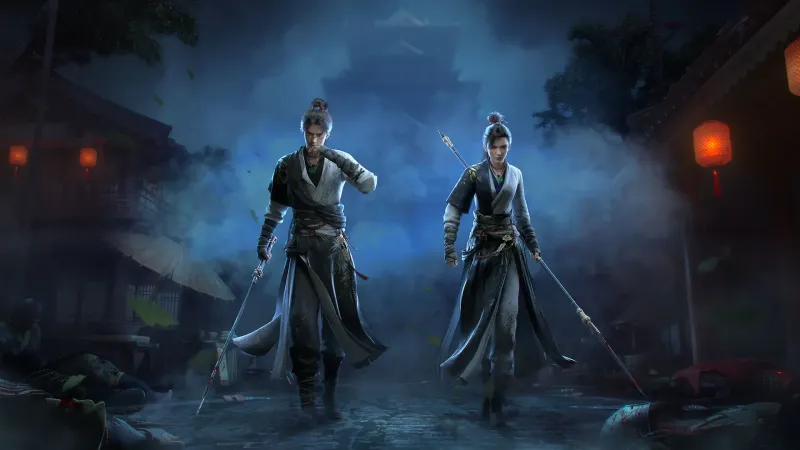
Where Winds Meet
Here's the thesis: Where Winds Meet is the best wuxia game ever made, and its Global launch was sabotaged by one of the laziest, most dishonest mischaracterizations I've ever seen in games media. People called it a "gacha game." It isn't - though it's not entirely free of the monetization patterns people associate with one. And that knee-jerk label - parroted by outlets that clearly didn't play more than the tutorial - poisoned the discourse before most people even downloaded it.
Let me fix that.
It's Not a Gacha Game. But Let's Be Honest About What It Is.
I need to address this up front because it's the elephant in the room. Yes, Where Winds Meet is published by NetEase. Yes, NetEase publishes gacha games. So let me lay the monetization out cleanly, because the lazy version of this conversation pretends there's nothing to discuss, and the dishonest version pretends it's Genshin Impact.
There is a cosmetic gacha. It's called Echo Beads - a banner with a 150-pull pity ceiling that drops outfits, mounts, hairstyles, and skill VFX. There's also a direct-purchase shop priced in Pearls, where individual outfits run from cheap up to around 2800 Pearls for the high-end sets. That part is not pulling - that's see the thing, pay for the thing, own the thing. And most of the cosmetics in this game you earn by playing: story rewards, event drops, achievement chains, region completion. The wardrobe fills up without ever touching the shop.
Here's what doesn't exist: there is no character banner. There is no weapon banner. There is no martial-arts banner. You don't pull for fighting techniques, you don't pull for boss unlocks, you don't pull for any of the systems that actually determine whether you win or lose a fight. Weapons, martial arts, talents, builds - every system that matters in combat is earned through play. Skill Theft from defeated NPCs. Sect quests. Exploration rewards. Mastery progression.
The release-week narrative was "NetEase gacha slop." What it actually meant - if it meant anything - was "NetEase publishes a game with a cosmetic gacha." True and uninteresting. The press conflated "has a gacha" with "is a gacha game" and those are not the same animal. A cosmetic gacha you can ignore entirely is not the same as a progression gacha that gates the characters you play and the powers they wield. WWM is the first; it isn't the second. Nothing about the combat, the world, the bosses, the story, or the buildcraft is touched by any of it.
A word on the energy system, since the people who insist "cosmetics-only is a lie" will point here next. Yes, there's a stamina cap. What it actually gates is gear-grinding - specific repeatable dungeon and outpost runs that drop progression materials. It does not gate the story. It does not gate world content, side quests, exploration, boss fights, martial-arts acquisition, or anything else that makes the game what it is. When my energy is out, I go run side stories, climb a mountain, do a fishing-village arc, find a hidden master - and by the time I come back, the bar is full and I'm stronger from the world content than the gear grind would have made me. The battle pass adds more energy supply, and the battle pass is genuinely cheap. It's not a paywall. It's a pacing mechanism, and it nudges you toward the parts of the game that are actually worth your time.
What this actually is: a single-player-first, open-world wuxia action RPG with souls-like combat at its core and an MMO co-op layer on top, available on PC, PS5, and mobile with full cross-play and cross-progression. Think Ghost of Tsushima's open-world structure meets Sekiro's parry mechanics, filtered through Crouching Tiger, Hidden Dragon's aesthetic sensibilities.
The Genre It Actually Belongs To
Where Winds Meet is a wuxia game. Not "wuxia-inspired." Not "wuxia-flavored." It's set in the Five Dynasties and Ten Kingdoms period (907-979 AD), a fractured era of Chinese history that provides the perfect backdrop for martial arts fantasy. You play as a wandering swordsman - a xia - navigating political intrigue, supernatural threats, and personal revenge. The narrative pulls directly from wuxia literary tradition: codes of honor, tragic masters, hidden techniques, the tension between personal loyalty and greater good.
The souls-like label is earned, but it's not the whole picture. Combat is deliberate. Stamina management matters. You have i-frames on dodge, parry windows, posture-breaking mechanics, and boss fights that will kill you in two hits if you get greedy. The difficulty is real - not "Elden Ring hard," but genuinely demanding in ways that reward mechanical mastery. I've died to the same boss fifteen times in a row and come back the next day with a different martial art and cleaner timing. That loop is intact on Global right now.
But unlike FromSoft games, Where Winds Meet gives you an actual open world with NPCs, towns, side quests with branching outcomes, and traversal mechanics that make exploration the point rather than a commute between combat arenas. Wall-running, vertical climbing, fluid combat-traversal - movement is expressive in ways that few open-world games even attempt. You can climb almost anything. You can parry arrows out of the air. You can kick enemies off cliffs. The physics sandbox is deeper than most games in this space.
World and Atmosphere
The open world is the star of the show. Everstone Studio built something that feels lived-in. Villages have daily routines. NPCs react to weather, to time of day, to your reputation. You can stumble into side quests by overhearing conversations in a teahouse. You can fish. You can brew tea. You can play Go. You can just sit on a cliff at sunset and listen to the wind.
On Global, you start in Qinghe - riverside towns, bamboo groves, farmlands stretching to the horizon. From there the map opens into mountain passes, ancient temple complexes, frontier garrisons, and eventually the outskirts of Kaifeng, the capital city. The environmental variety on Global alone is staggering. Bamboo forests give way to snow-capped peaks. Flooded marshlands border desert trade routes. Each zone has a distinct visual identity and its own set of traversal challenges.
The art direction is cohesive in a way that most open-world games aren't: every structure, every piece of clothing, every weapon model is grounded in the historical period. The research is obvious. And the music - traditional Chinese instrumentation (guqin, erhu, dizi, pipa) blended with orchestral scoring that knows exactly when to swell and when to pull back to silence. There are sections of this game where I stop moving just to listen.
Combat and Systems
This is where my 300 hours went. Where Winds Meet's combat system is built around martial arts - each weapon type carries multiple martial arts that change your moveset, your parry timing, your mobility, and your role in co-op. Switching martial arts mid-combo is encouraged and rewarded. The skill ceiling is high enough that I'm still learning new interactions.
On Global, you have access to swords, spears, twin blades, fans (yes, fans - don't laugh, they're terrifying), heavy blades, umbrellas, and rope darts - seven distinct primary weapon types, each with a distinct rhythm. Bows sit in the secondary-weapon slot for ranged utility. Twin-blade dual-wielding plays nothing like a single heavy blade. The spear has range and crowd control. The fans have debuff stacking and mid-range spacing tools. The umbrella is a parry monster. Switching martial arts is the real skill gap - knowing when to flow from a defensive sword art into an aggressive fan combo separates competent players from good ones.
The posture system works like this: both you and enemies have a posture bar. Landing hits and parrying builds posture damage. When it breaks, you get a critical riposte window. But the twist is in how martial arts interact with posture - some arts build posture faster, some have longer riposte windows, some let you recover your own posture on dodge. The buildcraft is real, and it's all available on Global.
Boss design deserves special mention. These aren't damage sponges. Almost every major boss has a distinct phase transition, environmental interaction, or mechanical gimmick that changes the fight. There's a boss in a flooded temple who changes the arena geometry mid-fight by breaking dams. There's a duel on a collapsing bridge where positioning matters more than DPS. The encounter design team understood that spectacle and mechanics need to reinforce each other.
The multiplayer layer adds co-op boss fights, competitive mini-games, and a surprisingly deep housing system. None of it is required. You can play the entire main story solo. I mostly did.
The Cultural Mission
Here's what sets Where Winds Meet apart from every other open-world game on the market: Everstone Studio is not just making a game. They're making a cultural artifact.
The developer has been explicit about this - they want to preserve and showcase Chinese history, traditions, architecture, music, poetry, and philosophy through this game. The Five Dynasties and Ten Kingdoms period was chosen deliberately. It's an era most people know about only through textbooks, and few games have explored it with this level of fidelity. The weapons are historically modeled. The tea ceremony mechanics are researched. The architecture is period-accurate. The calligraphy you see in UI elements and in-world signage is authentic.
I built a hub at https://wwm.vladislavstoyanov.com/ specifically to document this - the lore, the historical references, the cultural details that are easy to miss if you're not paying attention. There are poems embedded in item descriptions that reference actual Tang dynasty poets. There are side quests that function as miniature lessons in Chinese philosophy. There's a blacksmith questline that walks you through the actual metallurgy of the period. On Global, I've already documented 56 stories across 4 regions - and we're still catching up to what exists.
This isn't window dressing. It's the core identity of the game. And it's something no Western studio could or would do at this scale. If you care about games as a medium for cultural expression, Where Winds Meet is essential - and the Global version already delivers on that promise.
What Global Players Can Look Forward To
Let me be clear about something: I play on Global. I have never played on the Chinese server. Everything I'm about to say about CN content comes from watching patch notes, community discussions, and keeping tabs on what's ahead of us - not from firsthand experience.
The Chinese server launched on December 27, 2024. Global launched on November 14, 2025. That's roughly a 10.5-month content gap. If you're on Global, you are behind. You will see CN players discussing weapons, regions, and story arcs you don't have access to yet. You will occasionally get spoiled on boss fights that haven't reached us. This is the reality of a staggered global rollout for a live-service-adjacent game, and it's worth knowing going in.
Here's what I've gathered is coming our way - the stuff Global gets to look forward to:
Additional regions and story. The fully-realized Kaifeng urban zone is the big one - what we have on Global is impressive, but what's on CN turns it into a living, breathing capital city at a scale that dwarfs our current version. More chapters of the main story are already written and localized; they're just being released on an accelerated schedule.
Expanded traversal. CN has gliding and grappling-hook movement on top of the climbing and wall-running we already have on Global. Together they turn the vertical map into a real traversal grammar - climb, glide, hook, repeat. When this lands on Global, exploration changes shape.
More weapons and martial arts. Global launched with seven primary weapon types. CN has more, including elemental martial arts paths and additional weapon categories. New martial arts for existing weapons are also in the pipeline. If you're deep into buildcraft, there's a lot more coming.
Expanded multiplayer. More co-op raids with distinct mechanics, additional PvP modes, and housing system expansions that let you build out entire estates. Seasonal events with exclusive rewards and story content have been running on CN for multiple cycles; Global should start seeing those soon.
The good news: Everstone is running an accelerated catch-up schedule on Global. Patches are dropping faster than they did on CN at the same point in its lifecycle. The stated goal is eventual synchronization. I don't know when that happens, but the pace is encouraging - we're not being left to rot on a neglected server.
The better news: even in its current state, the Global version is a 100+ hour game with a complete narrative arc. The additional chapters on CN are extensions, not the resolution of a cliffhanger. You can start playing right now and have a full, satisfying experience while the rest rolls in. I've done exactly that for 300 hours and I'm not close to done.
Verdict
Where Winds Meet is a flawed masterpiece in the most literal sense. It has jank - the English localization, while massively improved since the November 2025 Global launch, still has rough patches. Some side quests have pacing issues. The multiplayer UI could use another pass. The content gap with CN is real and occasionally frustrating when you run into a wall and realize the next zone is coming "soon."
None of that matters against what it achieves on Global right now.
This is a game with a clear artistic vision, executed at a scale that rivals the biggest AAA productions, built by a studio that cares deeply about getting the details right. The combat is deep. The world is beautiful. The cultural mission is genuine. And the sheer volume of quality content available today - I have 300 hours and I'm not done - makes the fact that this game is free-to-play feel almost absurd. It would justify a $70 box price without breaking a sweat.
If you like souls-likes, play it for the combat. If you like open-world exploration, play it for the world. If you care about games as cultural expression, play it to see what happens when a studio treats its own history with reverence instead of using it as flavor text. If you've ever wanted a wuxia game that actually understands wuxia, this is it.
Just don't call it a gacha game without qualification. And don't wait - the stuff that's already here is worth your time. The stuff that's coming is just a bonus.
No comments yet. Be the first to share your thoughts!