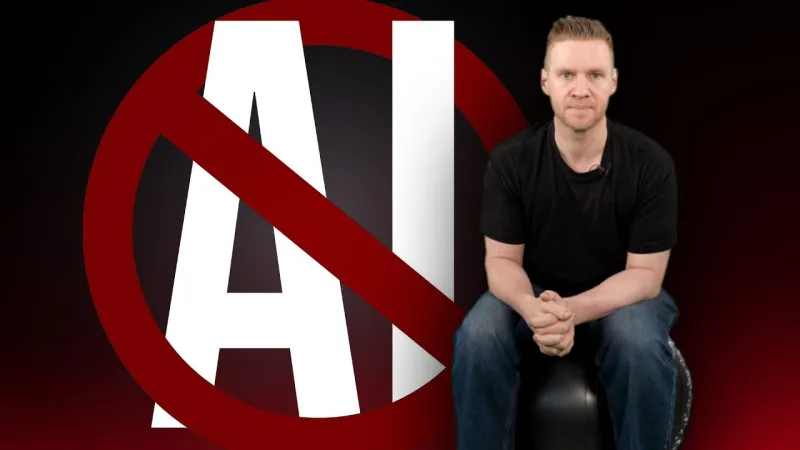
Jazza recently released a video sharing his evolving views on AI art. It's worth watching in full:
Jazza, I really respect you sharing this journey so openly. Changing your mind publicly takes guts, and I agree with you on more than you might expect. But I think you've swung from one extreme to the other, and the truth lives somewhere in the messy middle.
The thing that keeps nagging at me: AI lets people who couldn't create before finally express themselves.
I'm one of those people. Music has always been something I wanted to make. Back in high school, me and my friends messed around with Fruity Loops, Reason, eJay—none of us were real musicians, though I played acoustic guitar for a few years as a kid. Life happened, priorities shifted, and that dream sat on a shelf for almost two decades.
Then AI tools came along. And for the first time, I could actually make the music I'd been hearing in my head all those years.
I now have a music project called KAIYO//SHARD. Multiple albums on Spotify. Tracks ranging from K-pop to metalcore to drum & bass. 454 monthly listeners—not huge, but real people finding something they enjoy. I wrote about this journey on my blog because I knew people would judge me for it. But here's the thing: I put my heart and ideas into what I make. AI helps me shape it, but the soul is still mine.
Am I a "real" musician? Maybe not by traditional standards. But I'm finally expressing myself in a way that feels real to me—and that matters.
We've been here before. Multiple times.
Remember when digital artists were mocked for using Photoshop and tablets? "You're not a real artist!" people yelled. Remember when electronic musicians using computers were told they weren't real musicians? When Instagram made everyone a "photographer" and purists lost their minds?
Same arguments. Same gatekeeping. Same fears about craft being devalued.
We got a billion terrible brunch photos, yes. But we also got people discovering they actually loved photography. Some picked up real cameras. Some became professionals. The cream rose.
Your wife's painting proves the point you're arguing against
She didn't cry because the horse was technically accurate. She cried because you made it—the late nights, the sacrifice, the love in every brushstroke. No prompt will ever carry that weight.
But that's exactly why AI isn't competing with that kind of art. A handwritten letter hits different than an email, but we don't hate keyboards for existing. Context matters.
The corporate ad farm using AI to avoid paying artists and the teenager finally making album art for their SoundCloud aren't the same thing—even if both involve AI.
The real problems aren't the tool
The environmental costs, corporate exploitation, algorithms rewarding slop—these are real issues you're right to raise. But they're symptoms of capitalism and attention economies, not unique to AI.
Corporations exploited artists before AI existed. Algorithms rewarded garbage before Midjourney. Platforms eroded trust long before deepfakes. Blaming AI for these systemic problems is like blaming the printing press for propaganda.
You actually nail the real solutions in your video: regulation, renewable energy requirements, mandatory disclosure, UBI as a safety net. That's the fight worth having—not "AI bad," but "how do we make sure this doesn't leave everyone behind?"
On the theft question
This is genuinely complicated. Models trained on artists' work without consent—that's a real ethical issue worth sorting out.
But humans learn by studying other art too. You learned to paint by looking at other painters. The difference is scale and speed, not the fundamental process. I'm not saying that makes it okay—I'm saying the answer might be better compensation and consent systems rather than rejection of the whole technology.
On your proposals at the end—I'm with you
Honestly, your wishlist at the end of the video? I agree with almost all of it. Regulate the data centers. Require clean energy. Build proper disclosure systems. Create safety nets like UBI for a world where human labor becomes optional. Tax or license AI outputs to fund human creators. These are real, thoughtful solutions that address the actual problems instead of just being angry at the technology.
I want those guardrails. I want accountability. I want the corporations who can absolutely afford to pay artists to be forced to do so.
But here's my hope: that in this future we're building, there's also room for people like me.
Not the slop factories. Not the grifters churning out garbage for quick views. But the people who are thoughtful about this. Who put genuine passion and intention into what they create. Who aren't trying to replace artists but are just... finally able to participate in something they've dreamed about their whole lives.
Yeah, my music is on Spotify, Apple Music, YouTube—everywhere I can put it. But not because I'm chasing streams or trying to get rich. I just want to share what I make with as many people as possible. That's what artists have always wanted, right? To be heard.
I iterate on tracks. I think about themes and emotions. I care about what I'm putting out there—probably too much, honestly.
I'd like to think I'm not a slop machine. Maybe I'm fooling myself. But I hope not.
Where I land
I don't love the slop either. The gorilla videos and uncanny valley nightmares are exhausting. But I've also experienced firsthand what these tools can unlock for people who were previously locked out of creative expression entirely.
I'm a programmer and DevOps professional with 18+ years of experience. I use AI tools daily in my work—not blindly, but as a boost for prototyping, documentation, debugging. It doesn't replace my expertise; it amplifies it. And in my creative life, it finally gave me a door into music that I'd been knocking on since high school.
Maybe instead of "against" or "for," we could be thoughtful. Push for the regulations you mentioned. Demand transparency. Support human artists directly. But also leave room for the possibility that some people are finding something real here—even if the landscape is messy. Even if they needed a little help to get there.
We're all Team Humanity. I just think the team's big enough for some nuance—and maybe, hopefully, for people like me too.
Hi. It is somewhat regretful that this is where I leave a comment, because I was moved by your blogs on Monster Hunter, being a fellow and seeing what I too consider to be a decline on many fronts. I say 'regretful' because this perspective on using generative AI to compose music is frankly, rather cynical.
If I were to make a Monster Hunter analogy, this is roughly equivalent to someone going through an entire game using a one-shot mod, and then proclaiming that they truly love Monster Hunter and now share similar experiences with others who "properly"—I'm aware this is another can of worms—played it.
I don't know you, but for the sentiments we seemingly share about MH, I may be making a wishful gamble: I have a feeling that the more you dig into the truths about these corporations, the more you will feel repulsed by their products. My bigger problem with these tools are these tech oligarchs behind and the proven harms they are causing—my stance is clear in that I am not against generative AI as a technology in itself, but rather to encourage people to use local LLMs instead; intellectual ownership of art is an entirely different conversation.
Engaging in pro-or-anti-AI arguments is rarely fruitful, or any politics for that matter, as people often get personal. So I don't want to drag this on, just thought to give a nudge. Adam Neely has just put out a good video on the topic, if you're looking for more points to challenge your perspective on AI, that may be worth a watch. I believe both the bleak future of MH and AI "art" are simply rooted in "the abolishment of struggle." There is great intrinsic value in picking up an instrument, just as in monster-hunting itself, if you're not merely after the prestige that both things could potentially bring.
03 Feb 2026
adry
Edit: fellow fan; wishful gambit
03 Feb 2026
Vlado Stoyanov
Admin
Hey, thanks for taking the time to write this and for reading the Monster Hunter posts too. I genuinely appreciate the thoughtful tone.
You're right, and honestly, I feel that contradiction more than you might think. I'm constantly aware that there's a disconnect in how I treat two things I care about. I wouldn't want to one-shot a monster because that would strip away everything that makes the hunt meaningful to me. But then I'm more than happy to use AI tools to one-shot the creative process and give myself the gratification of expressing myself without the struggle. When you put it that way with the MH analogy, it's hard to argue they're not the same thing. I think I just haven't wanted to fully admit that to myself.
The corporate angle is something I agree with too and it's been on my mind a lot lately. The more I look into who's behind these tools and how they operate, the less comfortable I feel.
I think the honest answer is that this is an ongoing struggle for me. Trying to figure out what sits right and what doesn't as this tech keeps getting pushed into every corner of our lives at a pace that's hard to keep up with. I don't have it all figured out.
Part of why I got back into blogging is exactly for this reason, to have my own little corner where I can go back and see how I was thinking and feeling at any given moment. Social media is just a void. You post something, it's gone, you forget about it, you can never find it again. At least here I can trace how my views change over time, even if that means looking back and cringing at where I started.
Who knows, maybe a year from now I'll be writing a post about how AI was a curse all along. I genuinely wouldn't rule it out.
Thanks for the nudge. It landed.
03 Feb 2026
adry
Glad I didn't come across as combative, it really is refreshing to come across someone conscientious. I agree with you that our understanding and opinions aren't permanent; everyone has a blind spot or two.
In regards to MH, I believe if the series hopes to make a comeback, it's time the developers discern their core players and really listen to their wishes, rather than prioritizing sales over all else and tailoring it to the big numbers—most seem only to end up finding the title mediocre anyway, thus not contributing to its longevity.
If they should assign a task team to scour the internet for quality feedback, your organized posts would be a great resource. I hope to read on about your MH endeavors, whether it's to rediscover the old games' charm, or to find comfort in hearing others voice similar disappointments... Take care!
Hi. It is somewhat regretful that this is where I leave a comment, because I was moved by your blogs on Monster Hunter, being a fellow and seeing what I too consider to be a decline on many fronts. I say 'regretful' because this perspective on using generative AI to compose music is frankly, rather cynical.
If I were to make a Monster Hunter analogy, this is roughly equivalent to someone going through an entire game using a one-shot mod, and then proclaiming that they truly love Monster Hunter and now share similar experiences with others who "properly"—I'm aware this is another can of worms—played it.
I don't know you, but for the sentiments we seemingly share about MH, I may be making a wishful gamble: I have a feeling that the more you dig into the truths about these corporations, the more you will feel repulsed by their products. My bigger problem with these tools are these tech oligarchs behind and the proven harms they are causing—my stance is clear in that I am not against generative AI as a technology in itself, but rather to encourage people to use local LLMs instead; intellectual ownership of art is an entirely different conversation.
Engaging in pro-or-anti-AI arguments is rarely fruitful, or any politics for that matter, as people often get personal. So I don't want to drag this on, just thought to give a nudge. Adam Neely has just put out a good video on the topic, if you're looking for more points to challenge your perspective on AI, that may be worth a watch. I believe both the bleak future of MH and AI "art" are simply rooted in "the abolishment of struggle." There is great intrinsic value in picking up an instrument, just as in monster-hunting itself, if you're not merely after the prestige that both things could potentially bring.
Edit: fellow fan; wishful gambit
Hey, thanks for taking the time to write this and for reading the Monster Hunter posts too. I genuinely appreciate the thoughtful tone.
You're right, and honestly, I feel that contradiction more than you might think. I'm constantly aware that there's a disconnect in how I treat two things I care about. I wouldn't want to one-shot a monster because that would strip away everything that makes the hunt meaningful to me. But then I'm more than happy to use AI tools to one-shot the creative process and give myself the gratification of expressing myself without the struggle. When you put it that way with the MH analogy, it's hard to argue they're not the same thing. I think I just haven't wanted to fully admit that to myself.
The corporate angle is something I agree with too and it's been on my mind a lot lately. The more I look into who's behind these tools and how they operate, the less comfortable I feel.
I think the honest answer is that this is an ongoing struggle for me. Trying to figure out what sits right and what doesn't as this tech keeps getting pushed into every corner of our lives at a pace that's hard to keep up with. I don't have it all figured out.
Part of why I got back into blogging is exactly for this reason, to have my own little corner where I can go back and see how I was thinking and feeling at any given moment. Social media is just a void. You post something, it's gone, you forget about it, you can never find it again. At least here I can trace how my views change over time, even if that means looking back and cringing at where I started.
Who knows, maybe a year from now I'll be writing a post about how AI was a curse all along. I genuinely wouldn't rule it out.
Thanks for the nudge. It landed.
Glad I didn't come across as combative, it really is refreshing to come across someone conscientious. I agree with you that our understanding and opinions aren't permanent; everyone has a blind spot or two.
In regards to MH, I believe if the series hopes to make a comeback, it's time the developers discern their core players and really listen to their wishes, rather than prioritizing sales over all else and tailoring it to the big numbers—most seem only to end up finding the title mediocre anyway, thus not contributing to its longevity.
If they should assign a task team to scour the internet for quality feedback, your organized posts would be a great resource. I hope to read on about your MH endeavors, whether it's to rediscover the old games' charm, or to find comfort in hearing others voice similar disappointments... Take care!